
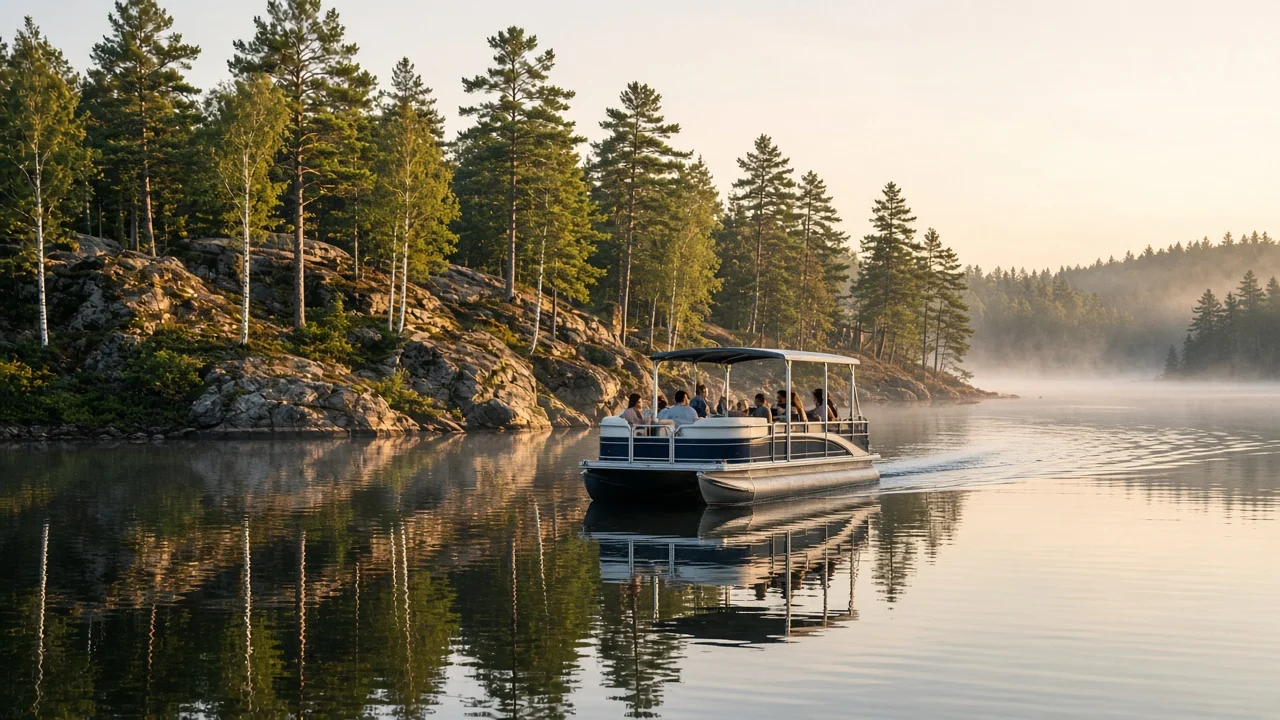
Few boats say “summer at the lake” quite like a pontoon. It’s the boat that carries the whole family to the sandbar, idles past the cottages at sunset with a cooler on board, and still has room for the dog. If you’re thinking about buying one, this guide walks you through what a pontoon really is, where it came from, the honest pros and cons, how to size and power it, what to inspect on a used one, and where to find the right boat in Canada.
What is a pontoon boat?
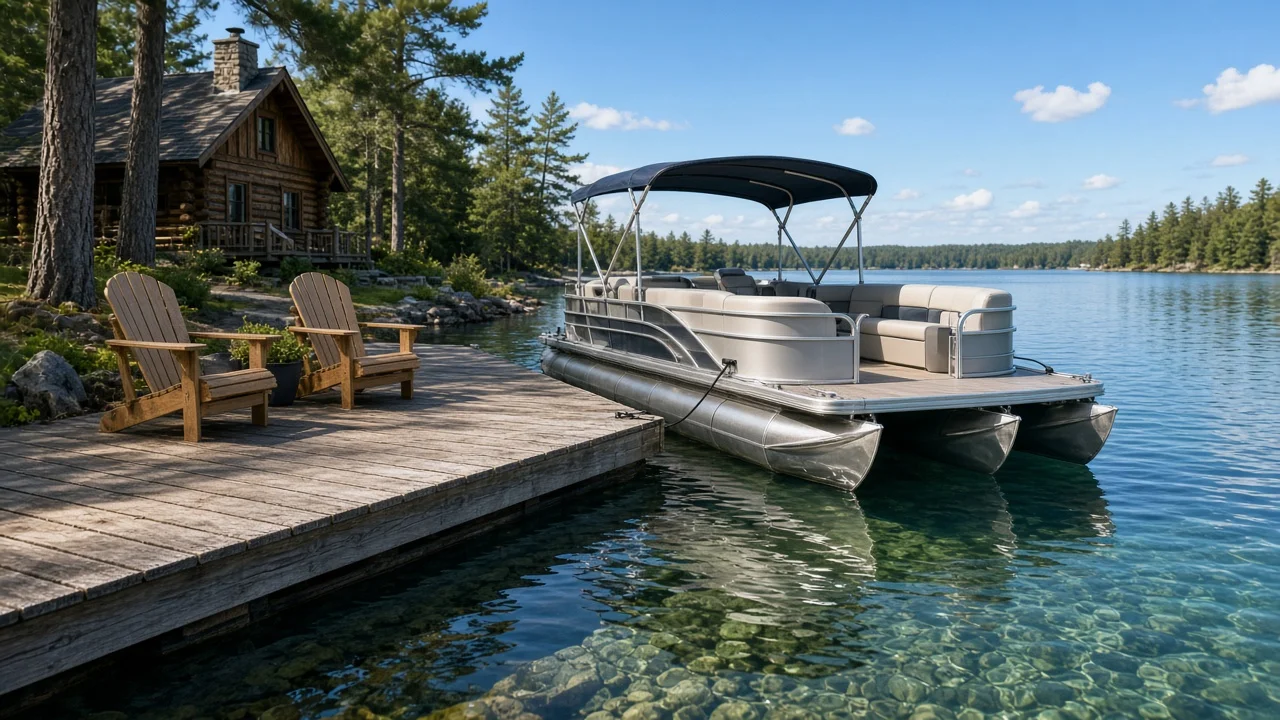
A pontoon boat is a flat-decked boat that floats on two or more sealed, cylindrical tubes (the “pontoons” or “logs”), usually made of aluminium. Instead of a traditional V-shaped hull, the deck sits on top of the tubes like a floating patio. That platform is then fitted with fencing, lounge seating, a helm console, a bimini top for shade and, at the stern, an outboard motor.
Because the deck is essentially a rectangle, a pontoon offers far more usable space than a conventional boat of the same length. Layouts range from simple fishing models with swivel seats and livewells to luxury lounges with wraparound sofas, changing rooms, swim platforms and premium sound systems.
A little history: a Minnesota idea that took over cottage country
The pontoon boat is generally credited to Ambrose Weeres, a farmer and mill owner from Richmond, Minnesota. In 1951, working with neighbour Edwin Torborg, he fastened a wooden deck to two columns of steel barrels welded end to end, added an outboard mount and steering, and tested the result on Horseshoe Lake. His theory was simple: a platform on floats would be steadier than a typical small fishing boat.
It worked. Weeres founded Weeres Industries in 1952 and took dozens of orders for his first model, the Empress, with more following a boat show in Chicago. An early lesson came after the first winter, when cold weather caused the sealed steel tubes to collapse and the design had to be revised. In 1990 the Minnesota legislature formally recognized Weeres as the inventor of the pontoon boat, and his hometown still calls itself the birthplace of the pontoon.
Canada has its own place in the story. Quebec’s Princecraft, founded in Princeville in 1954 as an aluminium boat and canoe builder, introduced its first pontoon line in 1985, and Canadian-built pontoons have been a fixture on our lakes ever since. Today’s boats bear little resemblance to oil drums and plywood: modern pontoons use marine-grade aluminium tubes, composite or vinyl decking and outboards from modest kickers to high-horsepower engines.
Pontoon vs. tritoon: two tubes or three?
Traditional pontoons ride on two tubes. A tritoon (or “triple-tube” pontoon) adds a third tube down the centre. That centre tube adds buoyancy and lift, lets the boat carry a larger outboard, and generally makes the ride steadier and drier in chop. Many tritoons also add lifting strakes or underskin panels to help the boat plane and turn more like a conventional runabout.
Two-tube pontoon | Tritoon (three tubes) | |
|---|---|---|
Best for | Calm lakes, cruising, fishing, swimming | Bigger lakes, larger groups, watersports |
Power | Small to mid-size outboards | Can be rigged with much more horsepower |
Ride in chop | Comfortable at moderate speeds | Steadier and drier, more confident in waves |
Purchase price | Lower | Higher, for the boat and the bigger engine |
Weight and towing | Lighter, easier to trailer | Heavier; check your tow vehicle’s rating |
If your lake is small and your plans revolve around swimming, sunset cruises and fishing, a two-tube boat may be all you need. If you boat on big water, such as Georgian Bay, Lake of the Woods or the larger lakes of Muskoka and the Laurentians, or want to pull a tube or a skier, a tritoon is usually worth the extra cost.
Who is a pontoon right for?
Families and groups who want space, shade and easy boarding for kids, grandparents and pets.
Cottage owners looking for a do-everything boat for cruising, swimming, fishing and running to the marina.
Anglers who want a stable platform; many fishing pontoons have rod holders, livewells and casting decks.
First-time boaters, since pontoons are stable, forgiving and intuitive to drive at cruising speeds.
Entertainers who value lounge seating, tables and a good sound system more than outright speed.
Pros and cons of owning a pontoon
The advantages
Space: a rectangular deck gives you more seating and walking room per foot of length than most other boats.
Stability: the boat sits level at rest, which makes it easy to move around, swim from and fish from.
Comfort: sofa-style seating, shade from a bimini top and easy access over the bow or stern gates.
Shallow draft: pontoons can usually reach beaches and shallow bays that deep-V boats can’t.
Versatility: one boat can handle cruising, swimming, fishing and, with enough power, light watersports.
Approachable: simple to operate and a gentle way into boating for new owners.
The trade-offs
Rough water: a classic two-tube pontoon is not designed for big waves; it can be wet and uncomfortable in a steep chop.
Wind: the tall fencing and bimini act like a sail, which makes docking in a crosswind harder.
Speed and handling: unless it’s a well-powered tritoon, a pontoon won’t feel like a sport boat.
Size on land: wide beams and long decks need a suitable trailer, tow vehicle and storage space.
Upholstery and covers: vinyl seating and canvas live outdoors and need care to last.
New or used?
Buying new gets you the latest layouts and engine technology, a manufacturer’s warranty and the chance to choose your floor plan, colours, engine and options. Dealers can also package the boat with a trailer, and many offer financing.
Buying used is where pontoons can shine for value. Aluminium tubes are durable, and a well-kept pre-owned pontoon can give years of service at a fraction of the new price. The key is condition: the engine, the tubes and the deck matter far more than the age on the brochure. Always get the engine’s hours and service records, and consider a professional marine survey or a mechanic’s inspection for a larger purchase.
How much does a pontoon cost in Canada?
Pontoon prices span an unusually wide range. A small, older two-tube boat with a modest outboard sits at the affordable end of the market, while a new, fully optioned luxury tritoon with a large outboard can cost as much as a high-end car or more. What drives the price:
Length and layout: longer decks and lounge or entertainment floor plans cost more than basic fishing or cruise layouts.
Two tubes or three: tritoon packages and performance hull options add significantly to the price.
Engine: the outboard is often one of the biggest single items, so horsepower matters.
Features: upgraded upholstery, audio, arches, ski towers, changing rooms and electronics all add up.
Age, hours and condition on the used market.
The best way to get a feel for real-world asking prices in your region is to compare current listings. Browse pontoon boats for sale on Vessel Star and filter by price, year and location to see what your budget buys right now. Prices on Vessel Star are shown in Canadian dollars.
Where to look for a pontoon
Vessel Star listings. Start with Vessel Star’s boats for sale to compare new and pre-owned boats across Canada in one place, or jump straight to the pontoon boats category. You can also search by builder, for example Princecraft boats for sale.
Boat dealers. Authorized dealers sell new boats, take trade-ins and can rig, service and store your pontoon. Find one near you in the Vessel Star dealer directory.
Yacht and boat brokers. Brokers list pre-owned boats on behalf of sellers and can help with paperwork, surveys and negotiation. Browse the Vessel Star brokers directory.
Boat shows. Winter shows are the best place to see many pontoons side by side and talk to manufacturers. The Toronto International Boat Show takes place each January at the Enercare Centre, and the Montréal Boat Show (Salon du bateau de Montréal) is held in late winter. Show-season promotions can be worth waiting for.
Private sellers and classifieds. You can find good deals privately, but do your own inspection and paperwork checks carefully.
Selling your current boat to make room for a pontoon? You can list your boat on Vessel Star.
Choosing the right size and power
Length
Pontoons are commonly sold from roughly 16 to more than 25 feet. Smaller boats are easier to tow, launch and store, and suit couples, anglers and small lakes. Mid-size boats around 20 to 22 feet are a popular family sweet spot. Longer boats carry bigger groups and handle open water better, but need more power, a bigger trailer and more storage space. Check the boat’s capacity plate, which shows the maximum number of people, weight and recommended engine power, and never exceed it.
Horsepower
Match the engine to how you’ll use the boat. Gentle cruising and fishing need far less power than pulling a wakeboarder or crossing a big lake with a full load of passengers. Underpowering a big pontoon is a common regret, because it makes the boat sluggish when loaded. Stay within the maximum shown on the capacity plate, and ask the dealer or seller how the boat performs with a typical load.
Used pontoon inspection checklist
Before you buy a pre-owned pontoon, walk through these points in person, ideally with the boat out of the water and then on a sea trial:
Tubes: look for dents, creases, cracks, corrosion and previous weld repairs. Ask whether any tube has taken on water; drain plugs or a pressure test can reveal leaks. Pay attention to the nose cones, which take the hits from docks and rocks.
Brackets and crossmembers: check where the tubes attach to the deck for cracks, loose fasteners and corrosion.
Deck: walk the entire floor and feel for soft or spongy spots, which can indicate rotting plywood underneath. Lift the carpet or vinyl at an edge if you can.
Fencing and gates: panels and rails should be solid, with gates that latch securely.
Upholstery: look for cracked or split vinyl, mildew and sun damage; open the seat bases to check for musty smells and rot.
Bimini top and covers: check the canvas, frame and zippers, since replacements add up.
Engine: ask for engine hours, the maintenance log and proof of winterization. Look for corrosion on the lower unit, check the propeller, and make sure the engine starts easily cold and runs smoothly on the water.
Steering and electrics: test the steering, gauges, navigation lights, bilge or livewell pumps and the stereo.
Trailer: inspect tires, bearings, lights, bunks, winch and frame rust. A tired trailer can be a hidden cost.
Paperwork: confirm the seller owns the boat, the hull serial number matches the documents and the boat is free of liens before any money changes hands.
Licensing and safety rules in Canada
Pontoons follow the same federal rules as other pleasure craft. A quick summary of the essentials, from Transport Canada:
Proof of competency: anyone operating a recreational boat with a motor (including an electric trolling motor) needs proof of competency on board, most commonly a Pleasure Craft Operator Card (PCOC). Renters can use a completed rental boat safety checklist for the rental period.
Pleasure Craft Licence: a boat with one or more engines totalling 10 hp (7.5 kW) or more that is mainly used in Canada needs a Pleasure Craft Licence, with the number displayed on both sides of the bow. Licences are now valid for five years and there is a fee to apply, renew or transfer. When you buy a used boat, the licence must be transferred to your name.
Safety equipment: you need a Canadian-approved lifejacket or PFD of the right size for each person on board, a reboarding device if the climb back aboard is more than 0.5 m, and a buoyant heaving line, plus other items depending on the boat’s length and set-up, such as a sound-signalling device, navigation lights, a bailer or manual bilge pump, a paddle or anchor, a watertight flashlight or flares, and a fire extinguisher if the boat has a fixed fuel tank or inboard engine. Check the full list for your boat in Transport Canada’s Safe Boating Guide.
Tip: provincial and local rules, such as speed limits near shore or restrictions on certain lakes, may also apply. Check before you launch somewhere new.
Winter storage and the real cost of ownership
In most of Canada, a pontoon spends almost as much time in storage as on the water, so budget for the whole year, not just the purchase price:
Winterization: each fall the engine needs to be properly winterized, and water systems drained. Many owners have a dealer or marina do this alongside an annual service.
Storage: options range from your own driveway or garage under a fitted cover, to shrink-wrapping, to indoor or outdoor storage at a marina. Look for storage and service providers in the Vessel Star marine services directory.
Dockage or a boat lift: if you don’t have your own dock, seasonal slip fees add up. At the cottage, a lift keeps the tubes out of the water between trips.
Insurance: it’s worth getting a quote before you buy.
Fuel and maintenance: oil changes, lower-unit service, impellers, propeller repairs and tube cleaning.
Upholstery and canvas: covers protect your investment from sun, rain, snow and critters.
Frequently asked questions
Do I need a licence to drive a pontoon in Canada?
If it has a motor, the operator needs proof of competency on board, usually a Pleasure Craft Operator Card, and the boat itself will usually need a Pleasure Craft Licence if its engines total 10 hp or more. See Transport Canada for full details and exceptions.
Are pontoons safe in rough water?
Pontoons are very stable in normal lake conditions, but they aren’t designed for large waves. A tritoon handles chop better than a two-tube boat. Whatever you drive, check the forecast, slow down in waves and keep passengers seated.
Can you pull a tube or a skier with a pontoon?
Yes, with enough horsepower. Many tritoons are rigged for watersports, and some have ski tow bars or towers. A lightly powered two-tube boat is better suited to towing kids on a tube than to serious skiing.
How long do pontoon tubes last?
Aluminium tubes are durable and can last for many years with care. Condition matters more than age: dents, corrosion and leaks are what to watch for, which is why an inspection is so important on a used boat.
Is a pontoon good for fishing?
Very. The stable, open deck makes it easy to cast, move around and bring a fish aboard, and fishing-specific layouts add rod holders, livewells and swivel seats.
When is the best time to buy a pontoon?
Shopping in the off-season, at the winter boat shows or in the fall when sellers want to avoid storage costs, can give you more choice and negotiating room. Buying in spring means you can sea-trial the boat and get on the water right away.
Ready to find your pontoon?
A pontoon is one of the easiest ways to bring family and friends together on the water. Decide how you’ll use it, set a realistic budget that includes ownership costs, inspect carefully and compare plenty of boats. Start your search with pontoon boats for sale on Vessel Star, talk to a dealer or broker near you, and enjoy many summers at the lake.